Wednesday, April 1, 2015

Islam as it is, not what you think it is!


Ashish Bindal

We all have a stereotype that all Muslims are terrorists. This is the perceived notion in the minds of almost all people and this mind-set is there for a very long time. However, in my personal opinion, this is not true. I have been living in Dubai for more than 10 years and this stereotype is just not true. I am studying in American University in Dubai, since last three years and have come across many Muslims and also made friends. I can vouch that this is not true. Not all Muslims are terrorists. Just because some of them have been seen doing acts of violence and being engaged in terrorism doesn’t mean that all Muslims are the same. We cannot give a general statement for all the people belonging to that community. 

For my art project, I took a plastic plate whose borders are green in color and white in the middle. The borders are of arabesque and floral design. I used golden color stained glass glitter glue, to write an Islamic verse by Omar Ahmed in the middle of the plate. The verse says:

“I think Islam has been hijacked by the idea that all Muslims are terrorists; I think that hijacks the spirituality and beauty that exists within Islam. I believe in allowing Islam to be seen in context and being judged on what it really is, not what you think it is”. 

Mr. Omar Ahmad is the founder of the Council on American-Islam Relations, Washington D.C. His Islamic sayings are very much recognized. His works influenced me and the above verse perfectly supports my argument that the stereotype view of most of the people about, Muslims are terrorist, is not true.

Salam from Palestine


Abdallah Ibrahim

Mahmoud Darwish was born on 13 March 1941 in Al Birweh, a quaint village in the Galilee, Mahmoud Darwish went on to live a life that is a poignant example of how far talent and determination, combined with a precarious life, can carry an individual from a simple background into the international halls of fame. The method used is poetry. Palestine was meant to be a land full of peace, yet war never seized. In my opinion Mahmoud Darwish wrote this work of literature because of the situation that Palestine is going through since 1948 till present day. Mahmoud Darwish’s poem is about peace. Is it related to Islam because Peace is mentioned in the Qur'an, the Hadith and it is one of God’s names “The Peaceful”. 
(Calligraphy, Diwani Style)


Beyond your Eyes


Mariam Hegazy

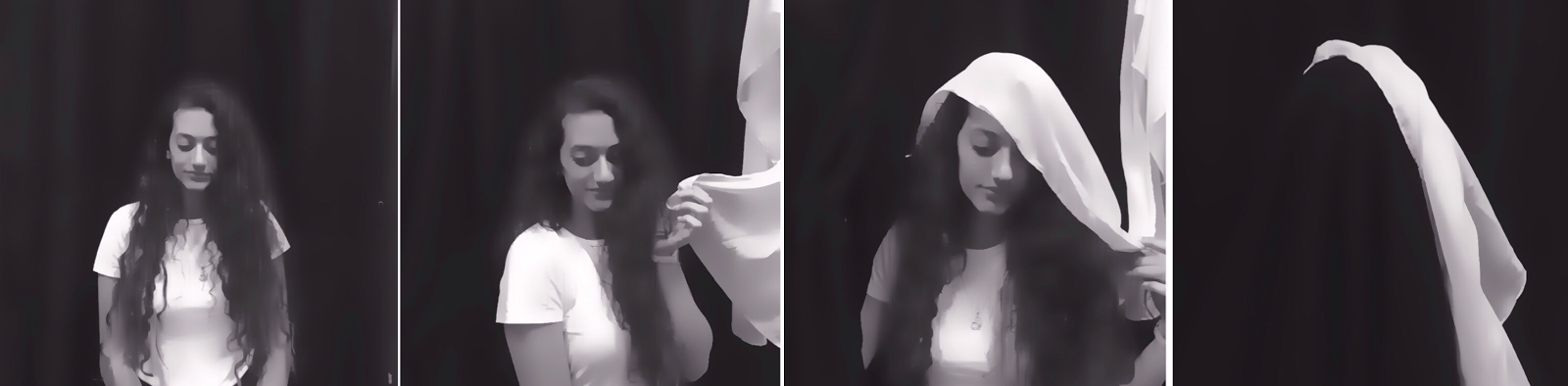
My art work is about the misconceptions of the women in Islam who wear the hijab. I used photography in my project to show the art and beauty of the work. My project displays the art of true beauty without the hijab. It then shows the first step of the idea of wearing the hijab and that it can slowly appear in a woman’s thoughts. She then decides to wear the hijab and it covers her beauty. The way I showed the hijab in my project is different than how women wear the hijab in real life to add mystery to the art piece. It shows how beauty can be easily transformed by a simple thought.

Most of the people in our world today judge a person by their appearance. They see with their eyes and make their own conceptions about a person before they give them a chance to speak. Several women in Islam are considered to be very religious and strict because they wear the hijab.

Some are even thought to be oppressed and subjugated because of their hijab. These stereotypes are given by those who don’t understand Islam and don’t understand why wearing the hijab is important in religion. 

The hijab was made to hide the beauty of a woman. It covers her hair, which can be the most beautiful feature in a woman, and her body. In Islam, a woman is like a pearl, pure and innocent. The hijab is like the shell that protects the pearl from any scratches or injuries, thus protecting the woman from the strangers around her.

I was inspired by two artists from the Middle East called Shadi Ghadirian and Shirin Neshat. They both create great artworks that show how women are viewed in Islam and the challenges they face due to the international preconceptions of women’s roles in an Islamic nation.

Shadi Ghadirian was born in 1974 in Tehran, Iran where she lives and works. She studied photography in Azad University in Tehran then began her professional career as a photographer. The subjects of her first two series were women.

Shirin Neshat was born in 1957 in Qazvin, Iran. She’s a visual artist who lives in New York City. She studied art in Los Angeles and she currently works in film, video and photography about Islamic art.